
The Genius from the Margins
How Hagi Put Romania on the World Football Map
LEGENDS OF THE GAME
1/9/20265 min read
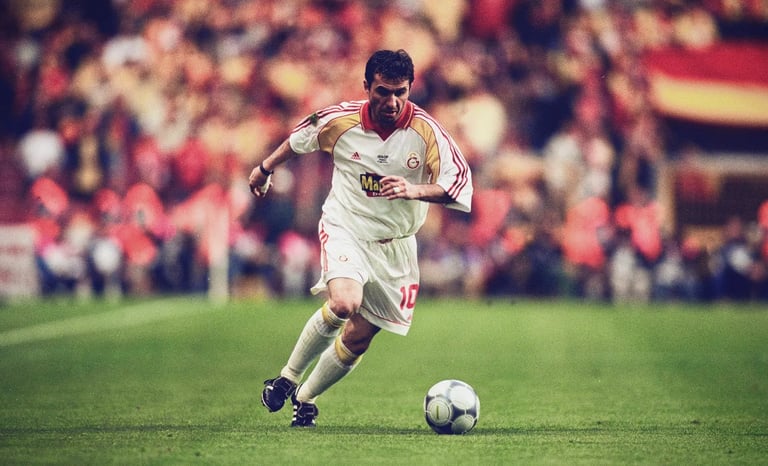
In the sweltering heat of the 1994 FIFA World Cup in the United States, a diminutive maestro from a nation rarely in the global spotlight orchestrated one of football's most enchanting underdog stories. Gheorghe Hagi, with his wand of a left foot, unyielding vision, and a flair that blended technical mastery with raw passion, led Romania to the quarterfinals, etching his name into lore as the "Maradona of the Carpathians." Yet, despite his brilliance—marked by 276 career goals in 646 club appearances (all competitions), seven Romanian Footballer of the Year awards, and triumphs in leagues across Europe—Hagi remains one of football's most underrated figures. Overshadowed by contemporaries from traditional powerhouses like Brazil's Ronaldo Nazário, France's Zinedine Zidane, or Argentina's Diego Maradona, Hagi's genius flourished on the fringes, elevating Eastern European football and leaving a legacy that extends far beyond the pitch into youth development and national pride.
Born on February 5, 1965, in Săcele, Romania, to parents of Aromanian descent, Hagi grew up in a modest environment near the Black Sea port of Constanța. Football was his escape and obsession from an early age. As a child, he would play for hours on end, often against older boys, honing his skills on rough pitches that demanded creativity and resilience. His talent was evident early; at just 10, he joined the youth setup at Farul Constanța, his local club, before moving to Luceafărul București, a talent development program run by the Romanian Football Federation. By 1982, at 17, he made his senior debut for Farul, scoring seven goals in 18 appearances, which propelled him to Sportul Studențesc in Bucharest. There, from 1983 to 1987, Hagi exploded onto the scene, netting 58 goals in 108 games as an attacking midfielder—a staggering tally that showcased his lethal left foot, dribbling prowess, and ability to dictate games.
This form attracted Steaua București, Romania's military-backed powerhouse. Joining in winter 1987, Hagi was instrumental in their 1987 European Super Cup victory over Dynamo Kyiv. Over three seasons at Steaua, Hagi scored 76 goals in 97 league games, winning three Romanian titles and establishing himself as a national icon. But the fall of the Iron Curtain in 1989 opened doors to the West. In 1990, he moved to Real Madrid for a then-record fee for a Romanian player, but struggled to adapt, scoring 20 goals in 84 appearances (all competitions) over two seasons. A stint at Brescia in Italy's Serie B followed, where he helped secure promotion, before a high-profile move to Barcelona in 1994 under Johan Cruyff. Again, consistency eluded him, with 11 goals in 51 games (all competitions).
It was at Galatasaray in Turkey from 1996 to 2001 that Hagi truly flourished, becoming a legend. He led the club to four consecutive Süper Lig titles, the 2000 UEFA Cup (beating Arsenal in the final), and the UEFA Super Cup against Real Madrid. Scoring 73 goals in 192 games (all competitions), Hagi's leadership and clutch performances endeared him to fans, who still chant his name today. His career stats—276 goals and countless assists in 646 club games (all competitions)—rival those of the elite, yet his association with "lesser" leagues like Turkey's and stints in lower divisions often diminished his global acclaim.
Hagi's underrating stems largely from geography, timing, and the media bias toward Western powerhouses. Hailing from Romania—a country without the footballing pedigree of Spain, England, or Brazil—he lacked the platform that amplified stars like Zidane, who benefited from France's 1998 World Cup win on home soil, or Maradona, backed by Argentina's storied rivalries. As one commentator noted, if Hagi were South American, he'd rank in the top 15 all-time lists. Instead, his Eastern roots and nomadic career—spanning five countries but without long-term success at "big" clubs like Madrid or Barça—relegated him to the periphery. He's often hailed as a "big-game player," delivering in clutch moments, but without sustained hype from mega-clubs like Manchester United or Juventus, his narrative faded. Analyses describe him as a "tactical problem modern football still hasn't solved," blending dribbling, passing, and shooting to disrupt defenses, yet his likable, grounded personality didn't court the controversy that fueled others' fame. In recent rankings, like GiveMeSport's list of underrated players, Hagi features prominently, with experts arguing his wand-like left foot would slot him into any all-time XI.
Nowhere was Hagi's genius more evident than at USA '94. Romania, dubbed the "Golden Generation" with talents like Ilie Dumitrescu, Florin Răducioiu, and Dan Petrescu, stunned the world under his leadership. They opened with a 3-1 victory over highly fancied Colombia on June 18 at the Rose Bowl. Hagi's audacious 35-yard lob over goalkeeper Óscar Córdoba—curving wickedly into the net—became an iconic World Cup moment, voted one of the tournament's best goals. He also assisted Răducioiu's opener, surviving sustained pressure to secure the upset. A gritty 1-0 win over hosts USA followed on June 26, with Gheorghe Popescu's penalty sealing progression. The round of 16 clash against Argentina on July 3 was electric. Without the suspended Maradona, Argentina still boasted stars like Gabriel Batistuta. Romania raced to a 2-1 lead in 18 minutes: Dumitrescu scored from Hagi's pass, Batistuta replied from the spot, then Dumitrescu struck again. Hagi sealed it in the 58th minute with a clinical finish, making it 3-1 before a late Argentine consolation. The 3-2 thriller propelled Romania to the quarters. Though they fell to Sweden on penalties after a 2-2 draw—Hagi scoring Romania's equalizer—the campaign, with Hagi's three goals and masterful playmaking, carried a nation to unprecedented heights. As Hagi later reflected, "I wanted to win the World Cup," but his performances announced Eastern Europe's arrival.
Beyond personal accolades, Hagi inspired a burgeoning Eastern European football identity. In the post-Cold War era, his exploits symbolized resilience and talent emerging from behind the former Iron Curtain. Romania's '94 run influenced a generation across the region, from Bulgaria's Hristo Stoichkov—who led his side to the semifinals—to Croatia's stars like Zvonimir Boban. He proved genius wasn't confined to Western powerhouses, fostering pride in nations where football became a vehicle for national expression. Hagi's 124 caps for Romania, second only to Dorinel Munteanu, included appearances in three World Cups (1990, 1994, 1998) and three European Championships (1984, 1996, 2000), underscoring his enduring impact.
Retiring in 2001, Hagi didn't fade away. Instead, he channelled his passion into the Gheorghe Hagi Football Academy, founded in 2009 near Constanța with an investment of over €10 million, much from his own fortune. Inspired by Cruyff's philosophy of simplicity and development, it became one of Southeastern Europe's premier talent factories. Taking over third-tier Viitorul Constanța, the academy propelled the team to promotions and, remarkably, the 2017 Liga I title—a fairy-tale for a youth-focused outfit. In 2021, Viitorul merged with Farul Constanța, where Hagi served as manager until June 2025, winning the 2023 league title. The academy has produced over 100 professionals, including his son Ianis (at Rangers), Răzvan Marin (Empoli), Tudor Băluță, and Denis Drăguș, fuelling Romania's return to majors like Euro 2024. Today, with 200 youths aged 6-19 training under his eye, Hagi pushes ambition: "Be the best you can be."
In 2025, at 60, Hagi's legacy endures. He released his autobiography ‘Hagi - Drumul Meu’ on February 5, participated in a September legends charity match against Portugal Legends (featuring Stoichkov on his World XI side and Figo on the opposition), and was ranked 82nd among the greatest footballers ever—above Philipp Lahm and Dixie Dean. Gheorghe Hagi's story is a testament to football's democratic spirit: a genius from the margins who redefined possibilities for his nation and region. While overshadowed by peers from traditional powerhouses, his 1994 heroics, inspirational role in Eastern Europe, and visionary academy ensure his influence transcends elite leagues. In a sport dominated by giants, Hagi reminds us that true greatness can emerge from anywhere—even the Carpathians.