Rivalry and Brand Value
The India–Pakistan Cricket Spectacle as a Global Broadcast and Sponsorship Asset
THE BUSINESS OF SPORT
11/11/20253 min read
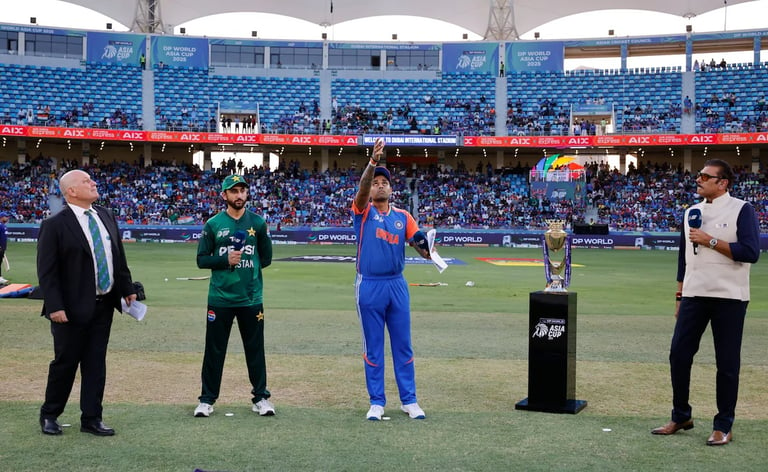
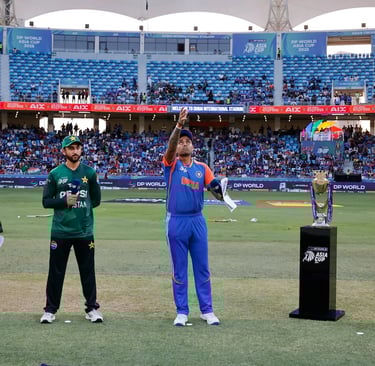
In the neon-lit cauldron of Dubai International Cricket Stadium on September 28, 2025, Tilak Varma stood tall under the desert floodlights, his unbeaten 69 off 53 balls carving a path through Pakistan's bowling like a knife through silk. With Rinku Singh blasting the winning boundary on the penultimate ball, India chased down 147 to clinch a thrilling five-wicket victory, securing their ninth Asia Cup title and completing an unbeaten campaign. Kuldeep Yadav's four-wicket haul had earlier orchestrated Pakistan's collapse from 113/1 to 146 all out, a meltdown that encapsulated the high-stakes drama of this eternal rivalry.
But this was no ordinary final—the first India-Pakistan Asia Cup summit clash in 41 years. It was a multibillion-rupee spectacle, where geopolitical tension met corporate gold rush. Off-field controversies, from no-handshakes to a bizarre trophy snub, only amplified the buzz. Yet beneath the memes and boos lay a colder truth: India-Pakistan cricket isn't just sport; it's the world's most lucrative broadcast and sponsorship juggernaut.
The Match That Stopped Two Nations
Pakistan, buoyed by openers Sahibzada Farhan (57) and Fakhar Zaman (46), raced to 84/0. Then came the spin chokehold—Varun Chakravarthy, Axar Patel, and Kuldeep ripping through the middle order. Jasprit Bumrah sealed the deal with fiery yorkers. India's reply stuttered to 20/3, but partnerships between Sanju Samson (24), Shivam Dube (33), and Varma turned panic into poise.
Captain Suryakumar Yadav's mock trophy lift became instant folklore, a defiant pose after the Indian team boycotted the presentation, refusing the silverware from ACC chief Mohsin Naqvi amid boos and chants. "We saw 'India Asia Cup 2025 Champions' on the screens—that was enough," Yadav later said, donating his match fees to the Indian Army.
Three clashes in the tournament—group stage (India won by 7 wickets), Super Four (6 wickets), and final—delivered escalating drama. Pakistan's fightback from group-stage hidings to the final earned respect, but India's dominance (now 10 wins in 13 T20Is since 2022) underscored the asymmetry fuelling the hype.
Viewership Volcano: Billions Glued, Records Shattered
If cricket is religion in the subcontinent, India-Pakistan is its Super Bowl on steroids. The final alone drew an estimated 450 million viewers across TV and digital, eclipsing the 2023 ODI World Cup clash's 400 million. In India, Sony Sports and SonyLIV peaked at 32 crore concurrent streams during the chase; in Pakistan, PTV's feed crashed under load.
MENA's 7.8 million South Asian expats turned CricLife and StarzPlay into viewing parties. Globally, the rivalry's "war minus the shooting" narrative pulled neutrals: ESPN+ in the US reported 50% spikes, while UK’s TNT Sports logged record Asian-diaspora tune-ins. Social media exploded—#INDvPAK trended for 48 hours, generating 2 billion impressions.
Why the obsession? History (Partition scars), rarity (no bilateral since 2012), and nationalism. Every six is a border skirmish won; every wicket, a diplomatic coup. As one fan notes, "The rivalry thrives more in imagination than reality," turning matches into cultural events. These matches have become more than just a game, they act as an avenue for patriotism.
Sponsorship Goldmine: INR 1,200 Crore and Counting
The DP World Asia Cup 2025 wasn't just titled—it was a commercial sell-out. Full inventory across on-ground, TV, and OTT raked in INR 700 crore pre-tournament, with the final pushing totals past INR 1,200 crore.
Title Sponsor: DP World returned with an 8-year deal, splashing logos on every perimeter board and broadcast bumper.
Global Partner: Spinny, the used-car unicorn, paid premium for mid-over slots and player-walkout branding.
Co-Sponsors: Wonder Cement (8-year lock-in), plus 17 others including FMCG giants, EVs, and renewables. Consumer brands flooded in, eyeing festive-season launches.
Ad Rates: India-Pakistan games commanded INR 16 lakh per 10-second TV spot—40% up from 2023. Digital packages (SonyLIV co-presenting) hit INR 30 crore each.
Broadcast features—low-entry logo integrations—drew 10+ brands priced out of big packages. In-stadium LEDs and global overlays gave ROI gold: a single Tilak six flashed Spinny to 300 million screens.
The exit of real-money gaming platforms left a hole, but corporates filled it. As one agency head quipped, "India-Pakistan is recession-proof—patriotism sells."
Beyond the Boundary: A Brand Untouchable
Critics decry the one-sidedness—Pakistan's batting "1980s mindset in 2025," per Wasim Akram. Controversies (no handshakes, trophy farce) dent the spirit. Yet the brand endures. FICCI estimates India-Pakistan fixtures have generated INR 10,000 crore over two decades.
For broadcasters, it's manna: Sony's rights till 2031 are a licence to print. For sponsors, it's emotional equity—align with victory, ride the wave. Even neutral venues like UAE profit: Dubai's hotels sold out, tourism boards cashed in on "cricket diplomacy."
Tilak Varma's heart gesture, Rinku's sprint, SKY's phantom lift—these are tomorrow's billboards. In an era of franchise fatigue, India-Pakistan remains pure, primal theatre. As long as borders bristle and billions watch, the spectacle will mint money—and myths.
The Asia Cup 2025 final wasn't just India's ninth title. It was proof: rivalry isn't about balance; it's about bankability. And this one? Priceless.