
Game of Two Halves
A Tactical Dissection of the 2005 UEFA Champions League Final – Liverpool F.C. vs AC Milan
THE PLAYBOOK
1/5/20265 min read
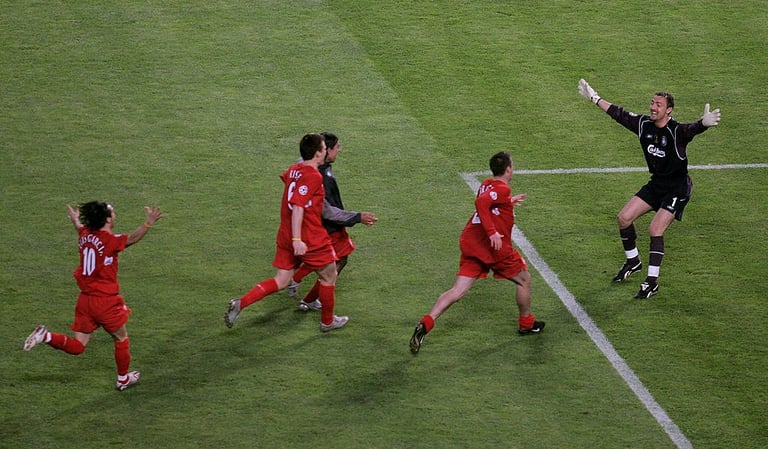
The 2005 UEFA Champions League final, held on May 25, 2005, at the Atatürk Olympic Stadium in Istanbul, Turkey, is etched into football folklore as the "Miracle of Istanbul." It pitted Liverpool F.C., managed by Rafael Benítez, against Carlo Ancelotti's star-studded AC Milan side. Milan, boasting a lineup featuring legends like Paolo Maldini, Andrea Pirlo, Kaká, and Andriy Shevchenko, were heavy favourites. Liverpool, the underdogs, had scraped through the competition with grit rather than glamour. The match ended 3-3 after extra time, with Liverpool triumphing 3-2 on penalties to claim their fifth European Cup. But what truly defined this encounter was its bifurcation: a first half of Milanese mastery and a second half of Liverpudlian resurrection. This article dissects the tactical nuances, focusing on Benítez's half-time adjustments that turned a 3-0 deficit into one of the greatest comebacks in sports history.
Pre-Match Context and Lineups
Leading into the final, AC Milan were seen as the epitome of tactical sophistication. They had cruised to the final, defeating Manchester United and PSV Eindhoven along the way, with a blend of defensive solidity and attacking flair. Liverpool's path was more arduous, including a dramatic semi-final win over Chelsea. Benítez, in his first season at Anfield, had instilled a pragmatic style, emphasizing organization and counter-attacks.
Milan lined up in a 4-3-1-2 diamond formation: Dida in goal; a back four of Cafu, Jaap Stam, Alessandro Nesta, and Maldini; Pirlo as the deep-lying playmaker, flanked by Gennaro Gattuso and Clarence Seedorf in midfield; Kaká in the attacking midfield role behind strikers Hernán Crespo and Shevchenko. This setup allowed Pirlo to orchestrate from deep, while Kaká's dynamism created chaos between the lines.
Liverpool started in a 4-4-1-1, often morphing into a 4-4-2: Jerzy Dudek in goal; Steve Finnan, Jamie Carragher, Sami Hyypiä, and Djimi Traoré in defense; a midfield quartet of Luis García on the right, Xabi Alonso and Steven Gerrard centrally, and John Arne Riise on the left; with Harry Kewell playing just off lone striker Milan Baroš. The plan was to flood the midfield, with Alonso sitting deep to shield the defense and Gerrard supporting in marking Kaká, while Kewell linked play. This formation aimed to neutralize Milan's central dominance and exploit transitions.
First Half: Milan's Tactical Supremacy
From the kick-off, Milan asserted control. Within 52 seconds, Maldini volleyed home from Pirlo's free-kick after Traoré fouled Kaká – a set-piece goal that exposed Liverpool's early disorganization. Milan's diamond midfield overwhelmed Liverpool's setup. Pirlo, unpressured, sprayed long balls to Crespo and Shevchenko, who pinned Liverpool's back four. Kaká exploited gaps behind Gerrard and Alonso, drifting into pockets and linking with the forwards.
Liverpool's issues were multifaceted. Their full-backs, Finnan and Traoré, were ineffective: Milan's lack of traditional wingers meant they had little defensive work but offered scant attacking width. Kewell, tasked with pressing Pirlo, struggled and was substituted in the 23rd minute due to a groin injury, replaced by Vladimír Šmicer. This disrupted Liverpool's rhythm. Gerrard, anchored to mark Kaká, couldn't surge forward, leaving Baroš isolated. Milan's compact defending smothered Liverpool's build-up, forcing long balls that Stam and Nesta comfortably dealt with.
The goals flowed logically from this dominance. In the 39th minute, Kaká burst through midfield, evading Alonso and Gerrard, and threaded a pass to Shevchenko, who squared for Crespo to tap in. Five minutes later, Kaká again split the defense with a through ball to Crespo, who lobbed Dudek. Liverpool's high line was repeatedly caught out, and their midfield lacked the energy to track runs. By half-time, Milan had 57% possession, 10 shots to Liverpool's 3, and a commanding 3-0 lead. Benítez later admitted the first half was a "disaster," with his side overrun centrally and unable to transition effectively.
Half-Time: Benítez's Tactical Revolution
Trailing 3-0, Benítez faced a monumental task. His half-time talk, immortalized in lore, emphasized belief – "We can still win this" – but it was the tactical tweaks that proved decisive. Finnan, nursing an injury, was replaced by Dietmar Hamann, a defensive midfielder. This substitution facilitated a formation switch to a 3-4-2-1: a back three of Traoré (left-center), Hyypiä (center), and Carragher (right-center); wing-backs Riise (left) and Šmicer (right, tucking in at times); Hamann and Alonso as the midfield pivot; Gerrard and García advanced behind Baroš.
The rationale was clear. The back three matched Milan's two strikers, reducing exposure to Kaká's runs by adding an extra defender. Hamann's inclusion doubled the holding midfielders, allowing them to man-mark Kaká and Pirlo more effectively, closing spaces that had been exploited. This freed Gerrard from defensive duties, enabling him to make surging runs into attacking areas – his natural strength. The wing-backs provided width, stretching Milan's narrow diamond and creating overloads on the flanks. Riise, in particular, was instructed to bomb forward and deliver crosses, exploiting Cafu's advancing age.
Benítez's changes addressed Liverpool's first-half frailties: midfield overload now favoured them (four vs. Milan's three), and the system allowed quicker transitions. It also capitalized on Milan's potential complacency and their defense's lack of pace – Nesta and Stam were solid but not athletic against dynamic runs. As Benítez noted post-match, the switch was inspired by a similar setup used against Juventus in the quarter-finals.
Second Half: The Comeback Unfolds
The impact was immediate and electric. Liverpool emerged with renewed vigor, pressing higher and winning second balls. In the 54th minute, Riise's cross from the left found Gerrard unmarked in the box; the captain headed powerfully past Dida, igniting hope at 3-1. Gerrard's liberated role was key – no longer shackled, he exploited spaces behind Pirlo.
Two minutes later, Šmicer, finding space on the edge of the box after Alonso drew defenders, rifled a low shot into the corner for 3-2. The wing-back system had created this opportunity: Šmicer's inward drift overloaded the center, pulling Gattuso out of position. Milan, stunned, retreated, allowing Liverpool to dominate possession (now 55%).
The equalizer came in the 60th minute. Gerrard burst into the box onto Baroš's backheel, drawing a foul from Gattuso. Alonso's penalty was saved by Dida, but he smashed in the rebound. This six-minute blitz – often called "the Istanbul six minutes" – stemmed directly from Benítez's tweaks. Hamann and Alonso neutralized Kaká, limiting him to peripheral involvement; Milan's diamond, once fluid, was stretched by Liverpool's width and Gerrard's energy. As the half wore on, Liverpool dropped deeper to protect the draw, countering sporadically.
Extra Time and Penalties: Grit Over Glory
Extra time saw fatigue set in. Ancelotti introduced Serginho for Seedorf, shifting Milan to a 3-4-1-2 with width. Benítez countered by moving Gerrard to right-back to mark the pacy Brazilian, restricting attacks but ensuring defensive stability. Chances were few: Dudek's miraculous double save from Shevchenko in the 117th minute preserved the tie.
Penalties decided the fate. Serginho skied Milan's first; Hamann, Cissé, and Šmicer scored for Liverpool, with Riise's effort saved. Kaká and Tomasson scored for Milan, but Dudek's save from the Shevchenko’s effort sealed victory. Gerrard was named Man of the Match for his all-action display.
Legacy: A Blueprint for Resilience
The Miracle of Istanbul transcended the scoreline. Benítez's half-time masterclass – from 4-4-1-1 to 3-4-2-1, adding midfield steel and unleashing Gerrard – exemplified tactical adaptability. It exposed how even elite teams like Milan could falter against energy and width. The match influenced modern football, highlighting the value of in-game adjustments and mental fortitude. For Liverpool, it revitalized the club; for Milan, it was a haunting "what if."
In essence, this was a game of two halves: Milan's first-half clinic in control versus Liverpool's second-half symphony of chaos. Benítez's changes didn't just overcome dominance; they redefined possibility.